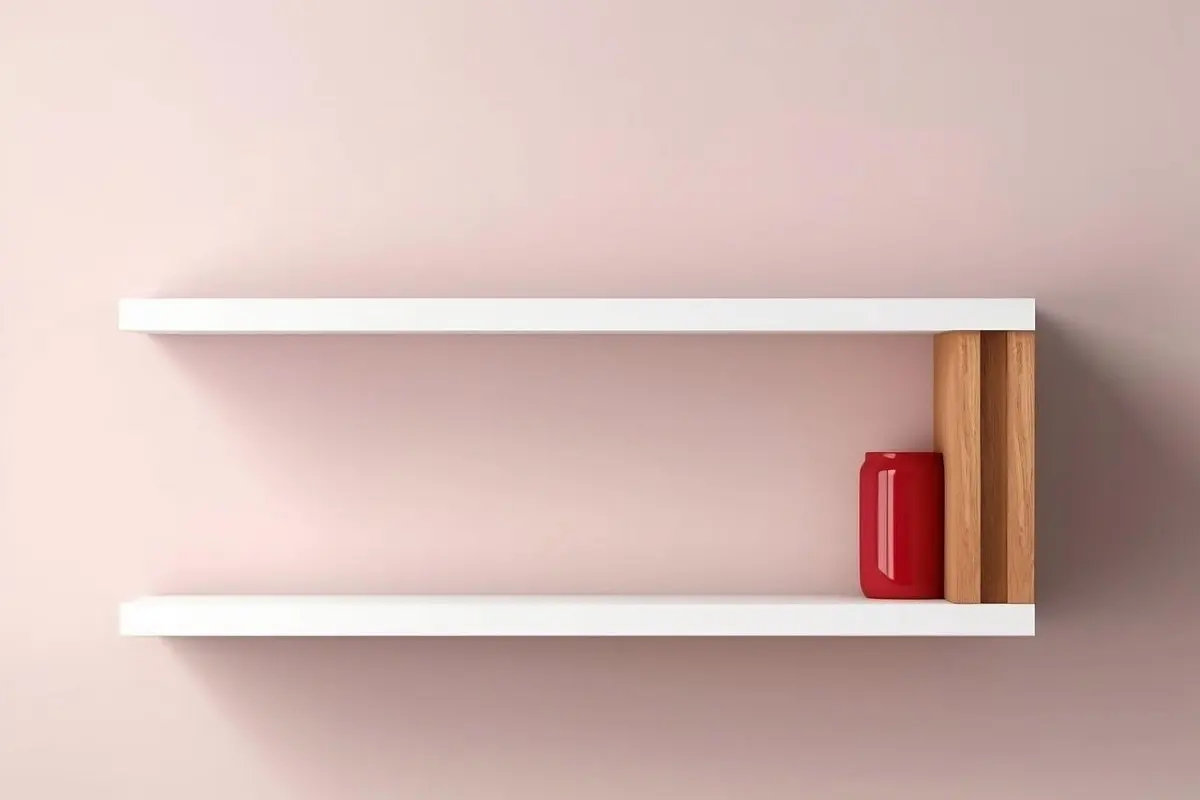
Worried your shelf will rip out of the wall and take your books with it? Here is how to hang floating shelves securely: find the studs, screw the bracket into them, and match the bracket to your load.
Shelves are a good first step into the wider world of home improvement projects that make a room work harder.
| Item | Value |
|---|---|
| Studs a shelf should straddle | At least two studs |
| Typical depth, most applications | 10 inches |
| Minimum thickness, solid wood | 1¼ inches |
| Hanging height, most rooms | 4-5 ft (eye level) |
| Height above kitchen countertops | 18-24 inches |
| Weight capacity range | About 20 lbs to 1,500 lbs, depending on bracket and installation |
The depth, thickness, height and weight figures come from Shelfology’s floating shelf guide, whose ratings were verified in July 2026, and the stud advice from a Homes & Gardens how-to published in May 2024. Figures can change, so check the source before you rely on them.
Work out what your wall is made of
Before you drill, identify the wall. Bob Vila’s guide, updated in October 2024, suggests knocking lightly: if it sounds hollow, it’s drywall, and if it doesn’t, it’s probably plaster. A nail that slides in easily also points to drywall, while a harder spot could be plaster or a stud.
Drywall is the most likely answer. A woodworker quoted by Homes & Gardens said around 90% of people have drywall walls, with studs running from floor to ceiling behind them.
Other surfaces need a different approach:
- Plaster: This Old House recommends a stud sensor with a “metal” setting to find where the lath is nailed to the stud.
- Concrete: usually found in basements or garages, and very difficult for a non-professional to drill through, according to Homes & Gardens.
- Brick: more common in older homes and apartments, and sometimes has a wood nog built in to support shelves.
Why a floating shelf needs studs
A floating shelf works like a lever. Shelfology’s guide explains that weight pushes down at the front and pries outward at the top of the bracket, so the fasteners must be anchored in wall studs or solid blocking, not drywall alone.
That is why Bob Vila says to attach floating shelves to a wall stud, which supports the weight best. A stud finder, which uses a magnet to detect the nails and screws in your studs, helps you locate them.
Plan the shelf around the framing, not the other way round. The contractor advice in Homes & Gardens is to choose a location straddling at least two studs, and to shift the shelf until it bridges them as evenly as possible.
How to hang floating shelves step by step
Gather a stud finder, a drill with bits to match your screws, a level, a pencil and safety glasses, plus the shelf kit, wall anchors and screws. Homes & Gardens lists the same kit.
- Mark the position. Decide the height and side-to-side placement, then use your level to draw a straight pencil line so the shelf won’t look crooked.
- Find the studs. On drywall, slide an electronic sensor along the wall until it beeps or shows a red line at a stud’s edge, then mark that point, as This Old House describes.
- Mark the screw holes. Hold the bracket inside the shelf line with its screw holes lined up with the studs, check it with the level, and mark each hole.
- Drill pilot holes. Start with small pilot holes. Add anchors only where a hole misses a stud.
- Fix the bracket. Screw it firmly to the wall.
- Slide on the shelf. Then inspect and adjust: check that it sits level and doesn’t wobble before you load it.
This sequence suits a shelf with a concealed bracket. Follow the maker’s instructions if your kit differs, because hole spacing and rod length vary.
What to do when there is no stud
Sometimes the stud is in the wrong place. Bob Vila’s installation guide says a bracket screwed into a stud needs no anchors, but plaster or drywall needs extra support.
The anchor type depends on the wall:
- Plaster: regular hollow wall anchors are fine.
- Drywall: use butterfly or toggle anchors.
- Heavy loads: CabinetNOW advises a heavy-duty anchor rated for more weight than you expect the shelf to hold.
Anchors are rated for how much weight they support, and Bob Vila suggests aiming for the low end of an anchor’s maximum rating to stay safe. Treat anchor-only mounting as a fallback: Shelfology says drywall anchors alone suit only very light decorative shelves.
If you are working in a basement, remember that some have metal studs instead of wood, per CabinetNOW. Check before you pick screws.
How much weight can a floating shelf hold?
It depends almost entirely on the bracket and what it is fixed to. Shelfology puts the range at about 20 lbs for big-box shelves up to 1,500 lbs for engineered mantel brackets.
Work out your load before you buy. This Old House’s shelf sizing guide gives these weights per foot of shelf:
- Paperbacks: approximately 10 pounds per foot
- Standard hardcovers: 20 pounds per foot
- Larger hardcovers: 25 pounds per foot
- Coffee-table art books: up to 30 pounds per foot
Size and placement matter too. Shelfology suggests these starting points:
- Depth: 10 inches for most applications, 10-12 inches for kitchens and 5-8 inches for bathrooms.
- Thickness: 1¼ inches minimum for solid wood shelves.
- Height: eye level (4-5 ft) in most rooms, and 18-24 inches above kitchen countertops.
Finishing touches that make shelves look intentional
If you plan to paint, CabinetNOW recommends paint-grade wood, which is less expensive because the grain won’t show. For a natural finish, pick a species that suits your wall colour.
Shallow boards suit small rooms, so shelves can slot neatly into a budget bathroom makeover. They also look sharp against a panelled wall, and a diy board and batten backdrop gives the stud-mounted shelf a clean line to follow.
Frequently asked questions
Can you hang floating shelves without studs?
Show answer
You can for very light decor, but it is the weaker option. Shelfology says drywall anchors alone are only for very light decorative shelves, and Bob Vila says drywall needs butterfly or toggle anchors.
How do I tell drywall from plaster?
Show answer
Knock lightly on the wall. According to Bob Vila, a hollow sound means drywall, and a solid one probably means plaster.
How high should I hang floating shelves?
Show answer
Start at eye level, which Shelfology puts at 4-5 ft in most rooms. Over a kitchen counter, the same guide puts the shelf 18-24 inches above the surface.
How long does installation take?
Show answer
CabinetNOW says that in just a few hours you can have floating wood shelves up. Spend the time on marking and stud-finding, since that is where most mistakes happen.